
Best Wellness Centre Website Marketing in Malaysia: What Leading Local Brands Do Differently
By Rozzario | Website, content, media and online business growth | Reviewed 10 July 2026
A wellness website should begin the experience before the client enters the centre.
A wellness centre can deliver an exceptional experience inside the premises and still lose the client before the first appointment.
The prospective client may discover the business through Google, Instagram, TikTok, a recommendation or a paid advertisement. They then look for practical reassurance: Is this centre suitable for me? Who will look after me? What happens during the service? How much will it cost? Where is the nearest branch? Can I book without waiting for a reply?
When the website gives vague answers, hides the process or makes every visitor start with a blank WhatsApp message, the marketing journey becomes harder than the in-centre experience. The person returns to Google, opens another tab and compares a competitor that explains the decision more clearly.
The best wellness centre website marketing in Malaysia is therefore not a single advertisement, a beautiful homepage or a busy social feed. It is a connected system that helps the right people discover the centre, understand the offer, trust the people behind it and take the next step with confidence.
The quick answer
| The Quck Answer | The strongest Malaysian examples make the offer easy to understand, show the real experience through services, people, reviews and visual content, and create an obvious path into booking or consultation. Urban Retreat Spa demonstrates a mature service-and-outlet journey. Eden Social Club sells a recurring wellness lifestyle. Advanced Integrative Wellness packages complex services into programmes. The opportunity for most centres is to combine those strengths with stronger local SEO, responsible evidence, purposeful video, technical quality and follow-up. |
What Is Wellness Centre Website Marketing?
Wellness centre website marketing is the coordinated use of a business website, Google visibility, local listings, expert content, social video, online reviews, advertising, booking technology and follow-up systems to generate suitable enquiries, appointments and returning clients.
The website is the owned centre of that system. Google, Instagram, TikTok, YouTube, Meta ads, email and WhatsApp should not behave like unrelated channels. Each one should move the prospective client towards the next decision.
| A basic wellness website | A website marketing system |
|---|---|
| Lists treatments | Explains which client need, concern or goal each priority service addresses. |
| Shows attractive photographs | Uses original photography and purposeful video to show the people, process, place and proof. |
| Has one generic contact form | Provides the correct action: appointment, assessment, call, WhatsApp or corporate proposal. |
| Mentions an address | Builds useful branch pages with maps, access, parking, practitioners, local reviews and booking. |
| Publishes occasional articles | Creates a connected service, problem, location and decision-content system. |
| Counts traffic and followers | Tracks qualified enquiries, bookings, attended appointments, rebooking and revenue by source. |
Every channel should move the same client relationship forward.
What Malaysian Wellness Brands Are Already Doing
Publicly visible Malaysian examples show that the market is moving beyond static brochure websites. Booking platforms, WhatsApp, service packages, branch information, reviews, awards, educational content and social channels are increasingly connected to the customer journey. The execution is not identical, because the businesses are not identical.
A day spa needs to sell atmosphere, availability, duration and price. A lifestyle club needs to sell routine, identity and membership value. An integrative or regenerative wellness clinic needs much stronger evidence, practitioner information, suitability guidance and consultation governance. The most useful comparison is therefore not “which website looks best?” but “which website answers its buyer’s decision most effectively?”
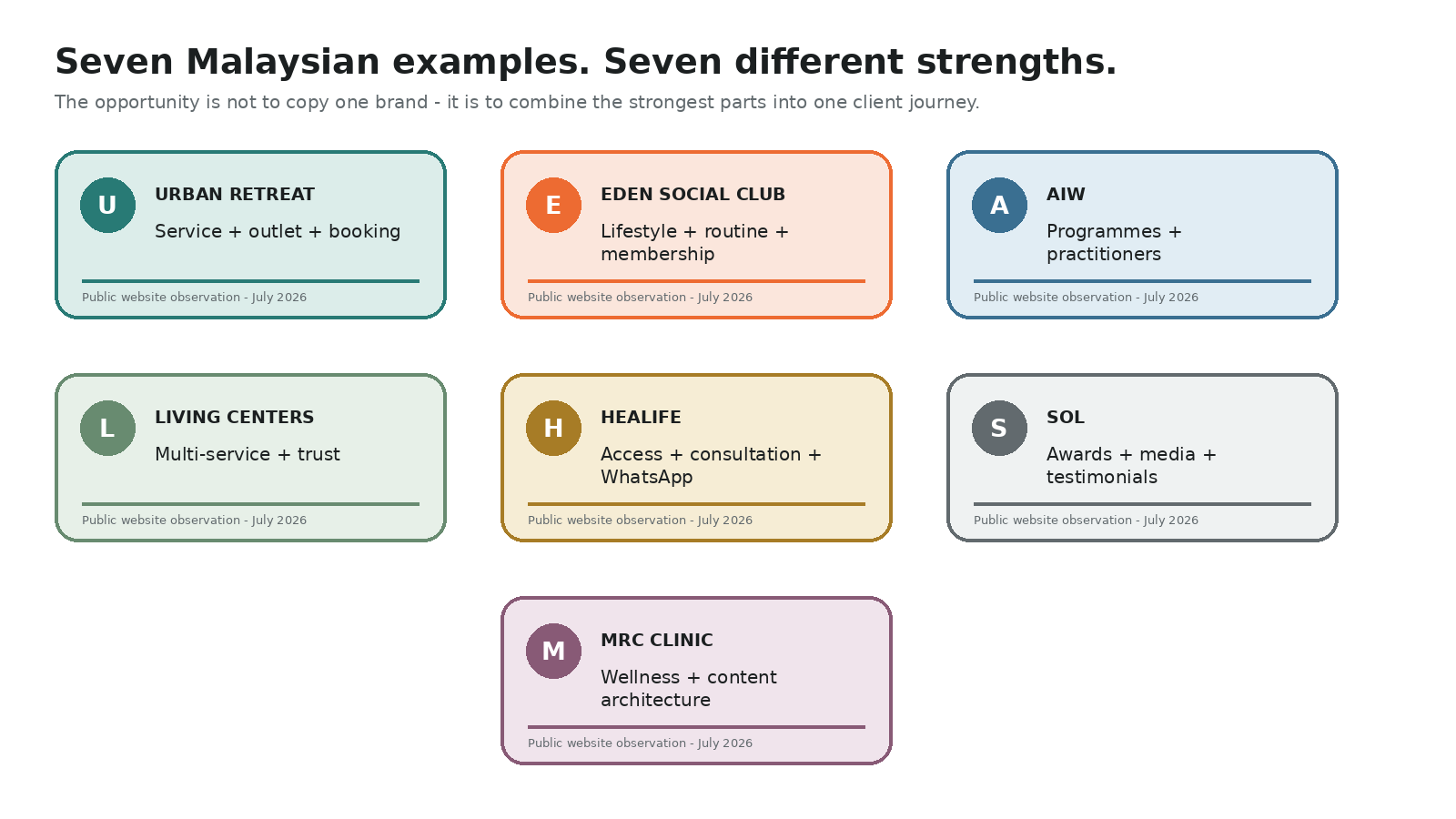
Different business models produce different website strengths.
Seven Local Examples Worth Studying
| Local example | Visible strength | Useful lesson | Official social / video |
|---|---|---|---|
| Urban Retreat Spa | Services, outlets, prices and duration detail, reviews, awards and direct booking. | Build each service and outlet as a complete decision journey. | YouTube TikTok |
| Eden Social Club | Movement, beauty, recovery, cafe and community presented as one lifestyle destination, with Momence scheduling. | Sell recurring routines and membership value, not only individual appointments. | |
| Advanced Integrative Wellness | Programmes, packages, success stories, medical-team profiles and repeated appointment calls to action. | Turn complex services into understandable programmes, then support claims and suitability carefully. | Success stories |
| The Living Centers | A broad regenerative and wellness offer supported by testimonials, awards and video presence. | Segment a large service portfolio by audience, concern and consultation stage. | YouTube |
| Healife | Wide service coverage, free-consultation calls to action, FAQs, reviews, facility information and WhatsApp. | Easy enquiry must be matched by technical maintenance, proofreading and simple navigation. | Instagram YouTube |
| SOL Integrative | Awards, corporate-wellness recognition, testimonials, media exposure and facility imagery. | Structure proof so that people can verify it instead of presenting one large logo wall. | Website |
| MRC Clinic | Distinct wellness, hair and aesthetic categories supported by articles and treatment pathways. | Keep mixed categories clear and connect education to the correct consultation route. | Website |
These examples are used for marketing commentary and comparison, not as endorsements of any health or treatment claim. Public pages and offers can change, so external links should be checked during future article reviews.
1. Position the Centre Around a Clear Client Journey
Many wellness websites try to represent relaxation, beauty, recovery, longevity, health screening, pain, stress, postnatal care and lifestyle improvement on the same opening screen. The language may sound impressive while leaving the visitor unsure where to begin.
A stronger homepage identifies the business category, its main audience, the location, its credible approach and the primary next step. The emotional brand idea can support this statement, but it should not replace practical clarity.
| A clearer opening statement | A practitioner-led wellness and recovery centre in Kuala Lumpur helping busy adults assess their needs, choose suitable services and build a realistic ongoing wellbeing plan. |
Eden Social Club is a useful example of category clarity because it organises the offer around movement, beauty, recovery and community. Urban Retreat Spa makes its outlet and service categories immediately visible. These approaches reduce the cognitive load of a large wellness menu.
2. Give Every Priority Service Its Own Decision Page
A long treatment menu may help an existing client who already knows what to book. It is a weak destination for someone arriving from Google or an advertisement with a specific need. Each commercially important service should have a dedicated page that answers the questions surrounding the decision.
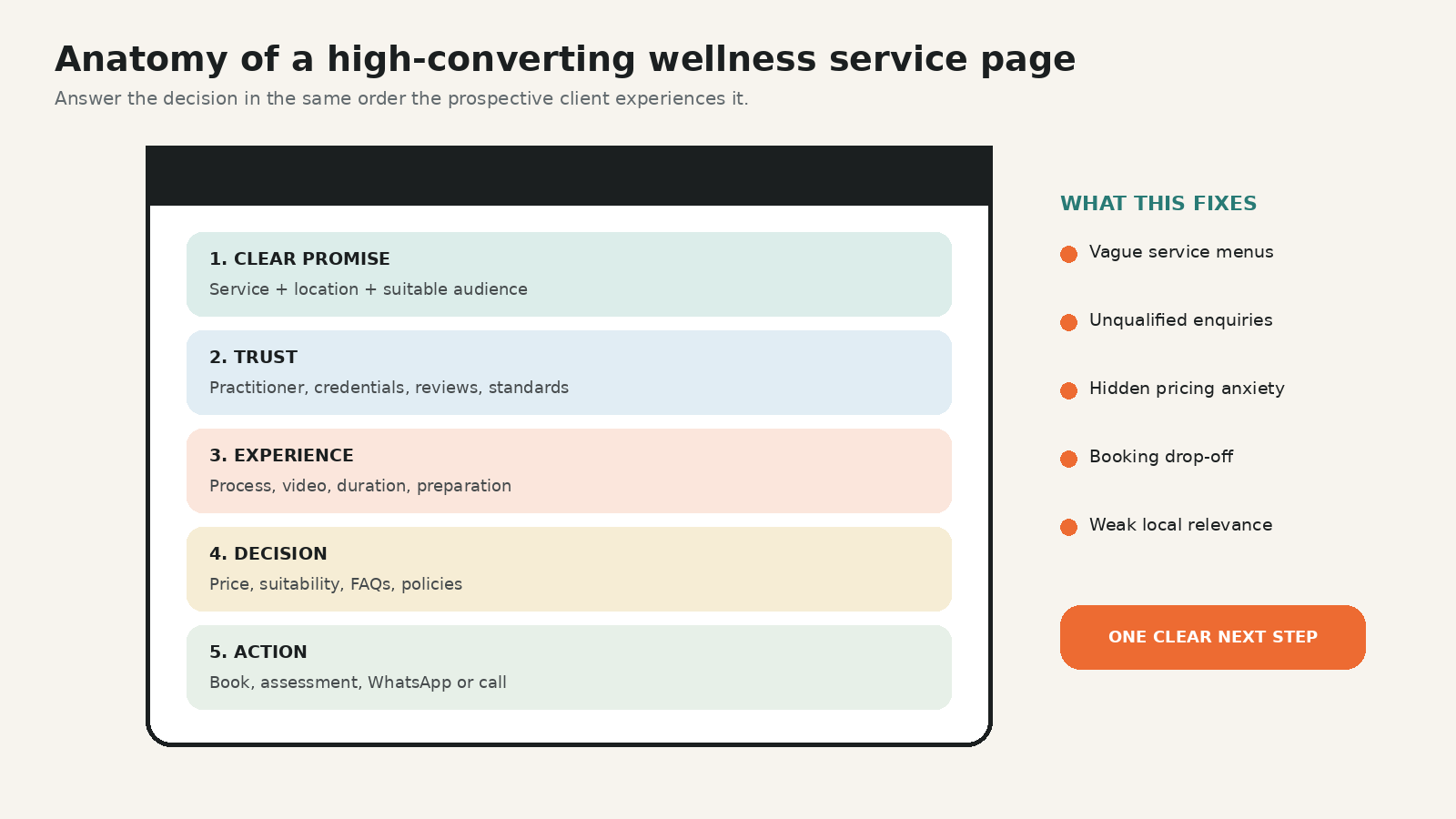
The strongest service pages explain relevance, trust, experience, decision and action in sequence.
- Use one clear page heading that identifies the service and location where appropriate.
- Open with a direct and responsible explanation of who the service is designed for.
- Introduce the practitioner and relevant qualifications before asking for trust.
- Show the experience from first enquiry or assessment through to follow-up.
- Publish the price, a starting price or a clear explanation of why assessment is required.
- Cover suitability, preparation, aftercare, limitations and practical policies.
- Place original video beside the part of the process it helps explain.
- End with one primary action: book, request an assessment, call or start a contextual WhatsApp conversation.
Advanced Integrative Wellness demonstrates the commercial value of programme and package architecture. However, the more medically complex the service becomes, the more important it is to support the marketing with named professionals, careful claims, suitability information and a properly governed consultation pathway.
3. Use Social Video Where It Removes Uncertainty
Wellness is experiential. A prospective client cannot feel the environment, observe the practitioner’s manner or understand the process from a logo and a list of treatment names. Video can close that gap, but only when it has a defined purpose.
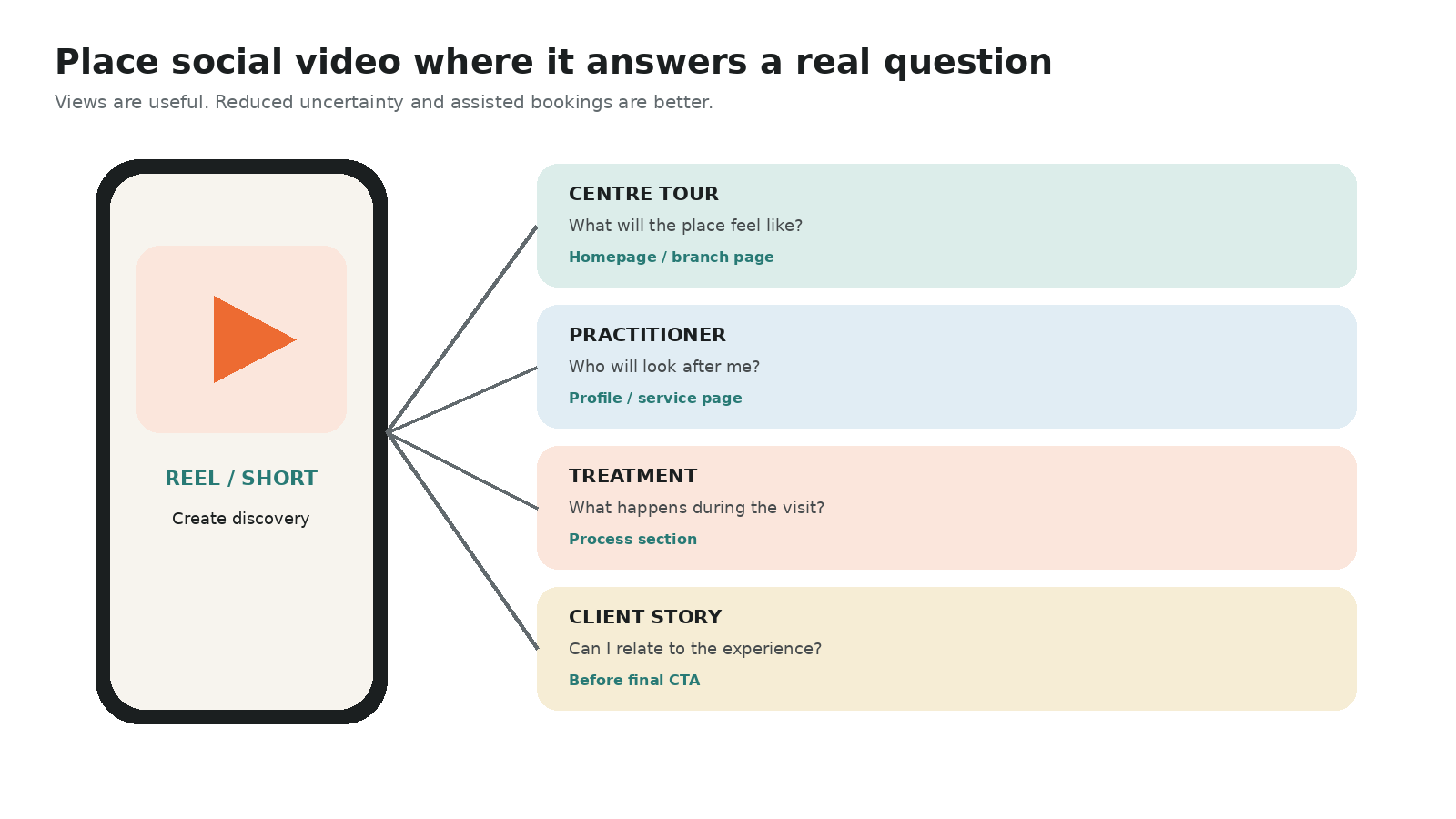
A social clip creates discovery; the matching website placement helps complete the decision.
| Video format | Question it answers | Best website placement |
|---|---|---|
| 30-second centre tour | What will the environment feel like? | Homepage and branch page. |
| Meet the practitioner | Who will be responsible for me? | Practitioner profile and relevant service pages. |
| Treatment walkthrough | What happens before, during and after? | Beside the treatment-process section. |
| Programme explanation | Why is this programme structured and priced this way? | Beside inclusions and programme comparison. |
| Client experience story | Can I relate to the decision and service experience? | After the service explanation and before the final action. |
| FAQ clip | Is this suitable, safe, uncomfortable or complicated? | Beside the matching written answer and responsible disclaimer. |
The Urban Retreat, The Living Centers and Healife social channels offer examples of how wellness businesses can use video beyond a static gallery. The important improvement is to bring the relevant video back into the owned website journey, add a text summary or transcript and track whether viewers continue towards a service page, consultation or booking.
Watch Malaysian Wellness Content Examples
| Urban Retreat Spa – official YouTube channelOpen channel What stands out: An established spa brand using video as part of a wider service, outlet, booking and social ecosystem. Marketing lesson: Use short experience-led content for discovery, then connect each video to the exact service or outlet page it supports. |
| The Living Centers – official YouTube channelOpen channel What stands out: Video can support practitioner, treatment and brand storytelling for a high-consideration wellness decision. Marketing lesson: Embed specific explainers beside practitioner and process information rather than sending all visitors to a general channel. |
| Healife Malaysia – official YouTube channelOpen channel What stands out: A local content source for facility, education and treatment-led video examples. Marketing lesson: Pair every video with concise written context, suitability guidance and a clear next action. |
| Yu Wellness – third-party experience videoWatch video What stands out: Third-party experience content can reduce uncertainty because it shows the visit through another person’s perspective. Marketing lesson: Use independent coverage carefully, with attribution and without treating one person’s experience as a guaranteed result. |
4. Show the People, Standards and Proof Behind the Experience
A wellness service is a trust purchase. Named practitioners, relevant credentials, original photography, clear governance, genuine reviews and a transparent consultation process are usually more persuasive than generic labels such as “best”, “advanced” or “world-class”.
Urban Retreat uses awards, press references, service imagery and visible customer reviews. SOL Integrative presents awards, corporate-wellness recognition, testimonials and media exposure. Advanced Integrative Wellness names members of its medical team. These are all forms of proof, but proof works best when it is specific, current and verifiable.
- Create an individual profile for every practitioner who materially influences the service.
- Explain their role, relevant qualifications, focus areas, languages and approach in plain language.
- Link awards and media references to an identifiable source where possible.
- Place service- and branch-relevant reviews near the decision instead of hiding all reviews in one carousel.
- Obtain written permission for identifiable client stories, images, testimonials and before-and-after material.
- Separate client experience from guaranteed outcome. Another client’s story is evidence of experience, not a promise of identical results.
5. Make Booking and WhatsApp Part of the Website Design
Booking should not feel like the prospective client has been pushed out of the website. Before transferring to an external booking platform, show the service, branch, duration, practitioner choice, price or deposit, cancellation terms and what will happen after confirmation.
Urban Retreat links into Zenoti. Eden uses Momence for scheduling and booking. These tools can remove administrative work, but the surrounding website still has to establish the decision before the transfer.
WhatsApp is valuable when the service requires a conversation. A contextual button is far stronger than a blank chat. A service-page message can pre-fill the service name, preferred branch and question. The reception team then needs a response sequence that confirms the goal, suitability, price, availability and next step.
Improve the Enquiry Path
- Instead of “Contact us for more information”, use a service- and location-specific action such as “Ask about the first wellness assessment at our Mont Kiara centre”.
- Instead of opening a blank WhatsApp chat, pre-fill the service name, branch and reason for enquiry.
- Instead of leaving the response time uncertain, explain when the team normally replies during opening hours.
- Instead of revealing every price after several messages, show the price, starting range or assessment requirement before the conversation.
- Instead of relying on individual memory, record the CRM stage, next follow-up date and team member responsible for the enquiry.
6. Build Local SEO Around Genuine Branches and Services
Wellness search is often local and mobile. A person searching for a recovery centre, spa, postnatal service, health assessment or wellness consultation usually wants an option they can realistically reach. Each genuine branch should therefore have a useful location page rather than appearing only as a pin in the footer.
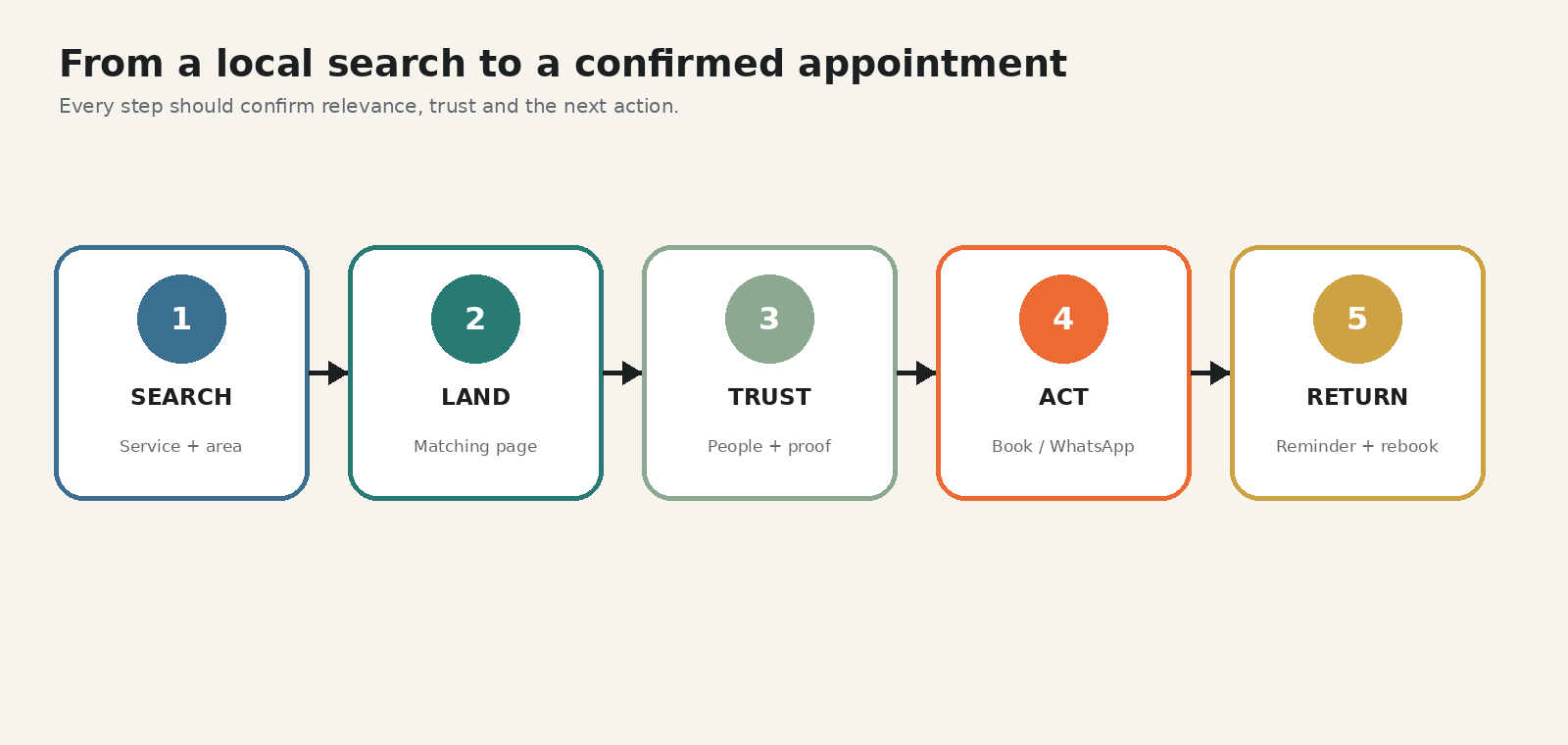
Local visibility succeeds when the service, location, proof and action remain connected.
- Original images of the entrance, reception, treatment areas and surrounding access.
- Accurate address, embedded map, parking, public transport and landmark guidance.
- Opening hours, telephone number, WhatsApp and branch-specific booking.
- Services and practitioners actually available at that location.
- Accessibility, languages, facilities and first-visit expectations.
- Local reviews and frequently asked questions.
- Consistent business name, address and phone information across the website, Google Business Profile, social profiles and booking systems.
Urban Retreat’s outlet architecture is useful because it brings service availability closer to the location decision. Healife also communicates practical access and consultation routes. The next level is to make every location page unique, genuinely useful and connected to local Google visibility.
7. Publish Content for Problems, Decisions and Programmes
A wellness blog should help a prospective client make a responsible decision. It should not exist simply to repeat broad wellness keywords. The strongest content begins with the questions asked before the person books, then guides the reader to a relevant service, assessment or programme.
| Search and decision stage | Useful article directions |
|---|---|
| Problem awareness | Why do I still feel tense after resting? What should I expect from a wellness assessment? |
| Service education | What happens during a lymphatic drainage session? How does an infrared sauna session work? |
| Comparison | Massage vs physiotherapy vs recovery therapy; a single session vs a structured programme. |
| Local decision | How to choose a wellness centre in Kuala Lumpur; what to check before booking in Mont Kiara or Petaling Jaya. |
| Commercial decision | How much do wellness programmes cost in Malaysia? What is included in a first consultation? |
| Corporate decision | How workplace wellness programmes are planned, delivered and measured. |
MRC Clinic’s separation of wellness, hair and aesthetic topics demonstrates why large mixed-category businesses need content architecture. Each article should lead to the correct service pathway rather than ending with a generic “contact us”.
8. Market Programmes and Memberships Responsibly
Selling one appointment at a time may not reflect how many wellness services actually create value. Programmes and memberships can make the journey easier to understand, improve continuity and create more commercially sustainable marketing – provided they are presented responsibly.
Advanced Integrative Wellness uses programme and package language. Eden Social Club sells an ecosystem built around repeated movement, recovery, beauty and community. These are different models, but both show that the offer can be larger than a list of isolated services.
| A useful programme page explains | Why it matters |
|---|---|
| The initial assessment or starting point | The client understands how recommendations are made. |
| Sessions, inclusions and review points | The programme feels structured rather than bundled. |
| Price, payment and cancellation terms | The commercial decision is transparent. |
| Support between visits | The relationship extends beyond the treatment room. |
| Who may not be suitable | Marketing respects safety and professional judgement. |
| The next decision | The reader knows whether to book, request an assessment or speak to the team. |
9. Use Paid Campaigns With Dedicated Landing Pages
Google Search advertising is suited to existing demand: a named service, location, price question or appointment need. Instagram, Facebook and TikTok are stronger for introducing the environment, practitioner, programme and client experience visually. Every campaign should land on a page that matches the promise and search intent – not a homepage containing every possible service.
| Campaign intent | Best destination | Primary conversion |
|---|---|---|
| Specific service search | Dedicated service page | Book or request an assessment. |
| “Near me” or location search | Branch page | Call, directions or branch booking. |
| First-visit offer | Offer page with full terms | Purchase or appointment. |
| Problem-aware social video | Educational assessment page | Qualified consultation. |
| Corporate wellness | Business programme page | Request a proposal. |
| Remarketing | Relevant proof, FAQ or programme page | Return to booking or WhatsApp. |
The campaign should be measured beyond clicks. A centre needs to know which source generated the enquiry, which service was requested, whether the appointment was confirmed, whether the client attended and whether they returned.
10. Build Multilingual Relevance Without Duplicating Weak Copy
Malaysia’s wellness audience is multilingual and culturally diverse. English, Bahasa Malaysia and Chinese content may be appropriate depending on the service, catchment and client profile. The objective is not to translate a few slogans; it is to translate the complete decision journey.
- Service explanation and suitability.
- Price, programme inclusions and policies.
- Practitioner information and credentials.
- Frequently asked questions and preparation.
- Booking, confirmation and follow-up communication.
- Local examples, terminology and search behaviour appropriate to each audience.
Urban Retreat’s visible multilingual review content also reflects the practical diversity of visitors in Kuala Lumpur. A multilingual strategy becomes more valuable when it is designed around complete user journeys rather than a homepage language switch with incomplete internal pages.
11. Connect the Website to Follow-Up and Retention
A confirmed booking is not the end of marketing. Appointment reminders, preparation guidance, post-visit follow-up, review requests, rebooking, membership communication and relevant programme education all affect the value of the client relationship.
The CRM should record the source, service interest, branch, booking outcome and follow-up status without collecting unnecessary sensitive health information through unsecured general marketing forms. Responsibility should be clear: who responds, when the next follow-up happens and when a lead is considered closed.
12. Measure Qualified Appointments, Not Vanity Metrics
| Area | Metric that matters |
|---|---|
| Search visibility | Non-brand service and location visibility; qualified organic enquiries. |
| Website | Service-page engagement, booking starts, WhatsApp clicks and completed forms. |
| Advertising | Cost per qualified enquiry, confirmed appointment and attended appointment. |
| Reception and sales | Response time, contact rate, enquiry-to-booking rate and no-show rate. |
| Retention | Rebooking, programme continuation, membership retention and client lifetime value. |
| Reputation | Review quality, velocity, response rate and service or branch relevance. |
| Content and video | Assisted booking, progression to service pages and returning visitors – not views alone. |
A Practical Website Structure for a Malaysian Wellness Centre
| Page or module | Purpose |
|---|---|
| Homepage | Clarify the centre, audience, location, approach, proof and primary next action. |
| Services hub | Help people choose by concern, goal or service category. |
| Priority service pages | Answer the complete decision and rank for specific search intent. |
| Programme and membership pages | Explain structured journeys, inclusions, price and continuity. |
| Practitioner profiles | Show the people, qualifications, languages and approach. |
| Branch pages | Support local search, directions, services, reviews and booking. |
| Client stories and reviews | Provide relevant, permissioned experience proof. |
| Knowledge centre | Answer problem, service, comparison, local and commercial questions. |
| Corporate wellness | Give HR and business decision-makers a separate proposal journey. |
| Book / contact | Provide service-aware booking, calls, WhatsApp and qualification routes. |
| Policies and privacy | Build confidence around cancellations, data, consent and expectations. |
Wellness Centre Website Marketing Checklist
☐ The homepage identifies the category, audience, location and main next step.
☐ Priority services have complete individual pages.
☐ Prices, starting ranges or assessment requirements are clear.
☐ Practitioners and relevant credentials are visible.
☐ Original photography and purposeful video show the real experience.
☐ Each genuine branch has a useful local page and current Google Business Profile.
☐ Booking, phone and WhatsApp journeys work properly on mobile.
☐ Reviews are genuine, relevant and placed near the decision.
☐ Health and outcome claims are supportable and reviewed by the right professional.
☐ Forms, privacy notices, consent and data handling are appropriate.
☐ Analytics track enquiries, bookings, attendance, rebooking and revenue source.
☐ The site has an active maintenance, security and content-review plan.
Frequently Asked Questions
What should a wellness centre website include?
It should include clear positioning, individual service and location pages, practitioner profiles, pricing or pricing guidance, the service process, suitability information, FAQs, reviews, original media, booking, WhatsApp or contact options, policies and useful educational content.
Is Instagram enough for a wellness business?
No. Instagram can create discovery and familiarity, but the website provides owned search visibility, detailed service information, trust, booking journeys, measurement and long-term control.
Should wellness centres display prices?
For straightforward services, visible prices reduce uncertainty. For complex programmes, publish a starting range, the inclusions and a clear explanation of why assessment is required before a final recommendation.
Should every treatment have its own page?
Every strategically important service with distinct search demand, audience, process, price or campaign should normally have a dedicated page. Minor variations can remain grouped when a separate page would not add meaningful value.
How should social video be used on the website?
Embed or link a specific video where it answers a specific question. Add written context or a transcript, keep the page fast and provide a visible fallback link when an external player fails.
Which marketing channel is best for a wellness centre?
Google is strong for people already searching. Social video is strong for discovery and experience. Email, WhatsApp and remarketing support follow-up. The best mix depends on the service value, location, capacity and client journey.
How long does wellness centre SEO take?
Technical and local improvements may create early progress, but competitive service and location visibility generally requires sustained content, authority, reviews, website quality and measurement.
Does a wellness centre need a marketing agency?
An agency becomes valuable when positioning, website development, content, photography and video, advertising, CRM and measurement need to work as one system rather than separate suppliers and disconnected campaigns.
How Rozzario Approaches Wellness Centre Website Marketing
Rozzario approaches the website as the centre of an online business-growth system. The work can combine research, positioning, website strategy, service and location architecture, conversion-focused design, original photography and video, local SEO, content, booking and WhatsApp integration, campaign landing pages, analytics and ongoing management.
The starting point depends on the business. A new centre may need a focused position and a lead-ready website. An established multi-branch brand may need service-page restructuring, local search, media production, booking optimisation and campaign measurement. A medical or high-consideration wellness provider may first need stronger governance, evidence and claims review before increasing traffic.
| Ready to turn your website into a client-acquisition system? | Request a Wellness Website & Marketing Audit from Rozzario. We will review the current website, local visibility, service positioning, booking journey, social video, follow-up and tracking to identify where suitable clients are being lost. |
Explore Rozzario Website Design & Development | Visit Rozzario
Sources and Malaysian Examples
External examples were checked on 10 July 2026. They are included for marketing analysis and reader reference. Website content, offers, social accounts and booking systems may change.
- Urban Retreat Spa
- Eden Social Club
- Advanced Integrative Wellness
- The Living Centers
- Healife
- SOL Integrative Wellness Centre
- MRC Clinic
- Urban Retreat YouTube
- The Living Centers YouTube
- Healife YouTube
- Yu Wellness experience video
